
Turning Amazon reviews into a video script is an edit job, not a conversion. You read what the page exposes, keep the themes buyers repeat, let the tool draft the scenes, then rewrite every first-person line into an attributed one — “reviewers on the product page say”, never “I bought this”. Attribution is manual: verified in LikeFlow's source on September 18, 2026, the draft arrives as a first-person testimonial.
Prices, rule text and the product behavior described here were verified September 18, 2026 — every source carries an access date in the footnote. LikeFlow, which publishes this page, sells the tool used in the examples, and the most useful paragraphs below are the ones describing what its draft gets wrong on purpose. Nothing here is legal advice.
The short version
- The review is a source of insight, not a script. What you take from it is the recurring praise, the repeated objection and the use case nobody planned. What you do not take is a stranger's sentence to put in a synthetic mouth.
- The generated draft comes out in the first person, and that is deliberate. The prompt behind the customer-review mode says, in LikeFlow's own source on September 18, 2026, “Write the script as a first-person testimonial from a real customer.” Publish that unedited and you are presenting as a testimonial something nobody said.
- Eight reviews. That is the whole corpus your script sees. Both code paths that build the request cut the list at eight, checked September 18, 2026, whether the product has forty reviews or forty thousand.
- On Amazon, the review text is often not there at all. Logged-out crawling frequently hits a sign-in gate, and what continues into the script is Amazon's own AI-written review summary plus buyer photos. You cannot quote buyers you never read.
- Three rewrites per video is the entire discipline. Say who is saying it, delete every number you cannot see on the page today, and cut any result a stranger's review cannot substantiate for you.
What can you actually take from an Amazon product page?
Four surfaces, and they are not interchangeable. Two of them are buyers speaking, one is Amazon speaking about buyers, and the difference decides how a line in your script has to be worded. Confusing them is the most common way an honest video ends up making a false statement about where its information came from.
| Surface | What it actually is | How a script may use it | The limit that bites |
|---|---|---|---|
| Individual review text | What a buyer wrote, in their own words, with a star rating | As attributed reported speech: “reviewers on the product page say…” | Only the first eight reach the model, and on Amazon this text is frequently withheld from logged-out sessions |
| The “Customers say” block | Amazon's own AI-written digest of review sentiment — Amazon describes these highlights as using “only our trusted review corpus from verified purchases” | Only as what it is: the review summary the page publishes. Never as a quotation from a buyer | No human wrote that sentence. Attributing it to “buyers” is inventing a speaker |
| Buyer-uploaded photos and video | The product in real rooms, at real scale, in real hands | As research for what your scenes should show | A file being visible on a page is not a license to republish it. Check the marketplace's terms before reusing any of it |
| Star rating and review count | The page's own two numbers | Only the figure visible on the page on the day you publish | Ratings move. A rounded-up flourish is not a flourish, it is a false statement of fact |
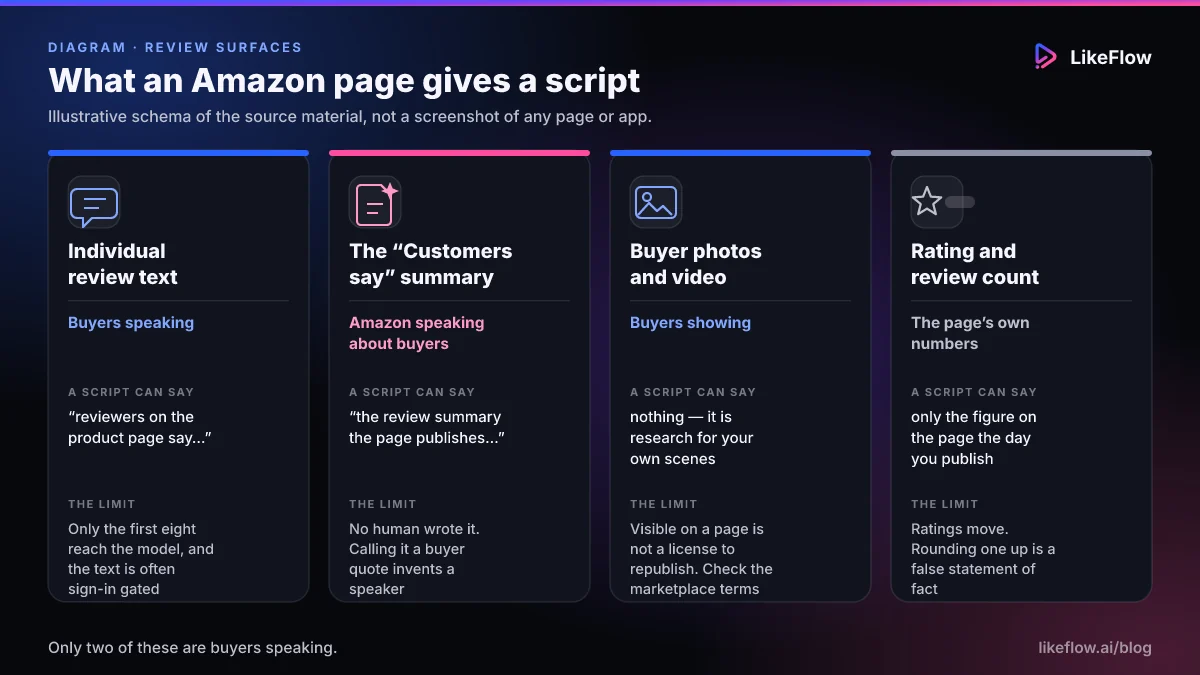
The sign-in gate deserves its own sentence, because it silently changes what your script is allowed to claim. Amazon serves logged-out sessions a sign-in prompt in place of review text, and LikeFlow's crawler treats that as final rather than retrying: when it happens, the run continues with the “Customers say” summary and buyer media only, logged in its own source on September 18, 2026 as “reviews are sign-in gated by Amazon — continuing with 'Customers say' summary and buyer media only.” If that is your situation, your video is not quoting anyone. Write “according to the review summary on the product page”, and stop there.
How do you turn a review into a script, step by step?
Seven steps. The tool owns three of them, you own four, and the four you own are where the video becomes publishable. The broader link-to-video workflow is covered separately in our Amazon affiliate video automation guide; this is only the script part.
- Pick a product with a real review corpus. Below a few dozen reviews there is no recurring theme to extract, only individual opinions, and a generator will still hand you a confident script built on one person's bad week.
- Read the reviews yourself before you generate anything. Five minutes, sorted by most recent and by critical. You are looking for three things: the praise that repeats, the objection that repeats, and the use case the listing never mentions.
- Note what the page actually exposed. Full review text, or only the summary Amazon wrote? Your answer here is the wording constraint for the whole script.
- Let the tool draft the scenes. This is the fast part and the least important one. The draft is raw material.
- Rewrite the person. Every line in which the speaker claims to have bought, owned, used or tested the product gets rewritten into attributed speech, or deleted. This is the step with legal teeth; the next section is entirely about it.
- Delete every number you cannot point to on the page. Ratings, counts, percentages, timeframes. If it is not on the page today, it is not in the video.
- Write the disclosure in both places — the post and the video. If you are an Amazon Associate, the Associates Operating Agreement requires you to state clearly and prominently: “As an Amazon Associate I earn from qualifying purchases.” That is the contract. The FTC is separate and reaches further: an affiliate commission is a material connection, and the FTC's own influencer guidance says that when the endorsement is made in a video, the disclosure “should be in the video and not just in the description uploaded with the video”. Put it on screen and say it out loud. The platform's AI-content label is a third obligation on top, and none of the three is written for you.
Why does the first draft arrive in the first person?
Because the prompt asks for exactly that, and we would rather write it here than let you discover it after fifty videos. In the customer-review mode, the instruction sent to the model reads, identically in both of LikeFlow's code paths and verified there on September 18, 2026:
“Write the script as a first-person testimonial from a real customer.”
There is no instruction to say where the information came from, and we found no button that adds attribution for you. A second line, present in the app's copy of the prompt, injects the product's real star rating alongside a ready-made example phrase — the braces are where the real number is slotted in:
“rated ${rating} stars by thousands of happy customers”
Look at “thousands”. The rating is real, pulled from the page. The quantity is not: it is fixed text inside the example, and it does not count anything. A product with twelve reviews still gets an example phrase talking about thousands of happy customers. It is the first sentence to search for and delete.
The same modes cut the review list at eight before it ever reaches the model — slice(0,
8) in the app path, [:8] in the backend path, both checked
September 18, 2026. We found no screen that lets you choose which eight. So the honest
description of what happens is narrow: a model reads up to eight reviews and a rating, and is
told to write as though it were the person who bought the thing. That is a prompt choice that
works acceptably for a brand describing its own product, and works badly the moment the video
is built on someone else's review.
How do you rewrite a first-person line so it is attributable?
One rule covers almost every case: the video may say what the reviews say, as long as it says that it is the reviews saying it. Three sentences per video, all of them on the script-editing screen, before anything renders.
| What the draft says | Why it fails | One way to rewrite it |
|---|---|---|
| “I ordered this and it arrived in two days” | A first-person account of a purchase that never happened, by a presenter who does not exist | “Fast delivery is the point reviewers on the product page repeat most” |
| “Rated 5 stars by thousands of happy customers” | “Thousands” is fixed example text in the prompt, not a count of anything on the page | “4.6 stars on the product page today” — or cut the number entirely if you cannot see it while you edit |
| “Sarah from Ohio says it changed her mornings” | A named person you never spoke to, whose permission you do not have, and who may not exist | Use no names at all: “one of the most repeated comments is…” |
| “It cleared my skin in a week” | A results claim that a stranger's review does not substantiate for you — and you are the advertiser | Describe the feature and leave the outcome out of the video |
| “Verified buyers love the battery life” — when the review text was sign-in gated | You are attributing words to buyers you never read | “According to the review summary Amazon publishes on the page…” |
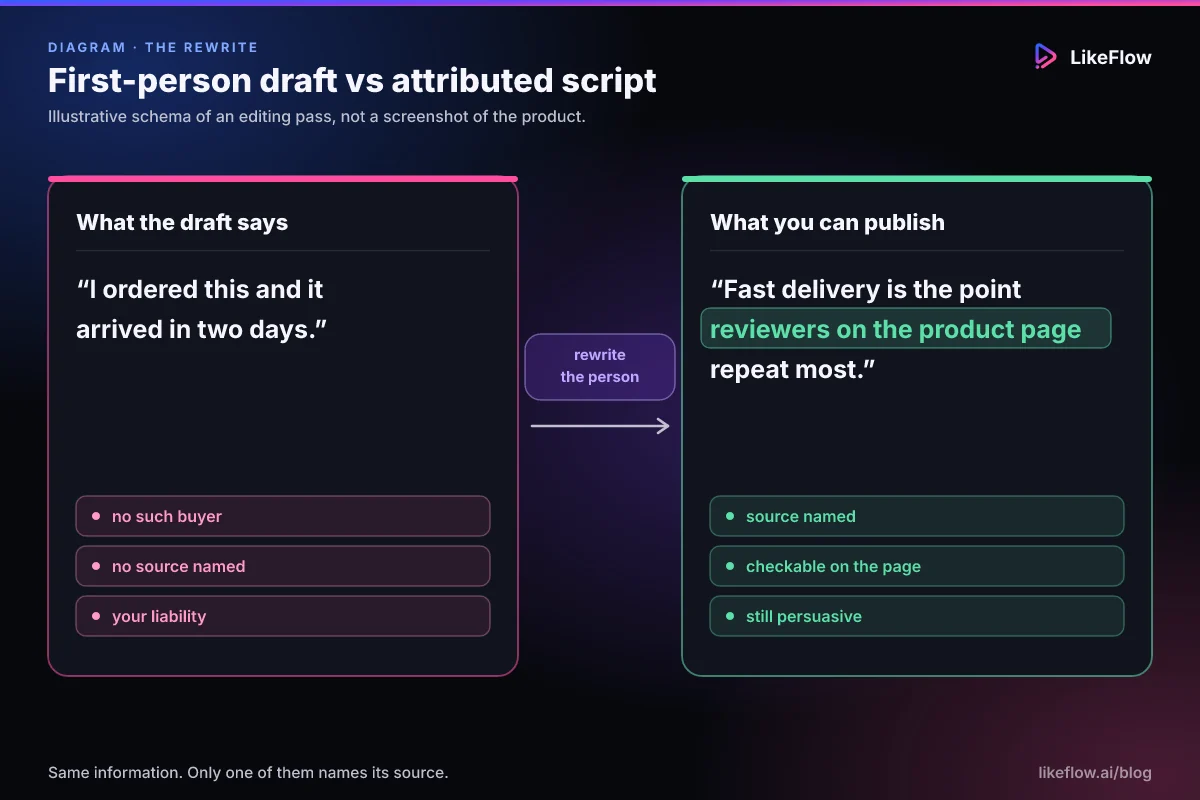
Two checks close the edit. First: read the opening scene and ask “who is asserting this?” If the answer is “a buyer who does not exist”, rewrite it. Second: find every number in the script and confirm it is on the product page right now. A number you cannot point at does not go in the video.
Which claims can a review actually carry?
Reviews are strong evidence of one thing — what buyers said — and weak evidence of everything else. Sorting your script's sentences into those two buckets takes about a minute:
- Frequency claims: usable, with attribution. “The complaint reviewers repeat is that the cable is short” is a claim about the reviews, and the reviews are right there on the page.
- Product attributes: usable, but they become your claims. Moving “fits a 15-inch laptop” from a review into your script means you are now the one asserting it. Check the listing.
- Outcome, health and earnings claims: not usable. A stranger's good week is not substantiation, and this is the category that draws attention.
- Comparative superiority: not usable from reviews. “Better than the brand-name one” in a review is an opinion; in your ad it is a claim you have to support.
- Counts and ratings: usable only as shown today. Copy the figure, do not round it, and re-check it if the video runs for months.
There is one upstream risk no rewriting fixes: if the listing carries incentivised or purchased reviews, a script derived from them repeats them faithfully. Provenance is inherited, including the bad parts. Products whose reviews all arrived in the same two-week window are worth skipping for reasons that have nothing to do with your video.
Where is the FTC line on using someone else's review?
Quoting a genuine review is not the problem; misrepresenting it is. The FTC's Rule on the Use of Consumer Reviews and Testimonials, 16 CFR Part 465, effective October 21, 2024, makes it a violation for a business to write, create or sell a consumer review or testimonial that materially misrepresents, among other things, “that the reviewer or testimonialist exists” or “that the reviewer or testimonialist used or otherwise had experience with the product, service, or business that is the subject of the review or testimonial” — quoted from the rule text on September 18, 2026. A synthetic presenter saying “I bought this and I love it” is a testimonial from someone who does not exist, describing an experience nobody had. The same sentence, rewritten to say that reviewers on the page report fast delivery, is a report.
That is the whole of the line as it touches this workflow. The full picture — endorsement disclosure, platform AI labels, what the rule does and does not reach — is a separate article of its own, not this one. Nothing on this page is legal advice, and if you are running this at scale, take your own.
What if the product has almost no reviews?
Then the review angle does not open, by design. In LikeFlow, the “User Review” and “User Review (UGC)” angles are gated on crawled review evidence: with none, the option is disabled behind the message “Customer review evidence required”, and a submission attempted anyway returns “Product lacks review evidence.” — strings and gate read in the product's own source on September 18, 2026. The other angles keep working.
The gate is looser than it sounds, which is the part worth knowing. It counts as evidence if there are review texts, or a “Customers say” summary longer than a short fragment, or buyer-uploaded video, or buyer-uploaded images. So the angle can open on a product whose review text you have never seen. That is precisely the case where the rewrite table above matters most: the draft will still be written in the first person, and you will have nothing to attribute it to except Amazon's summary.
What this workflow does not do
Stated plainly, because a guide that only lists capabilities is an advertisement:
- It does not attribute anything for you. There is no “cite the review” control, and the draft arrives with no marker of provenance. The attribution sentence is written by you, on the editing screen.
- It does not check whether a review is genuine. It reads what the page publishes. Fake reviews upstream become fake claims downstream.
- It does not ask permission from the person who wrote the review. Which is why the advice above is to use no names.
- It does not post, schedule, or apply a platform's AI label. You download an MP4 and publish it yourself.
- It does not clone your face or voice. You choose from a fixed presenter library.
- It does not read the marketplace's terms for you. Reusing review text or buyer images runs into the store's own rules, and those are yours to check.
- It does not export watermark-free on the free tier. Free-plan renders carry the LikeFlow watermark; watermark-free export is what the paid plans advertise.
What does this cost, in credits and in minutes?
What a review-derived video costs depends on which mode you pick. LikeFlow publishes two rules side by side: “1 credit = 1 30-second video”, and “UGC review videos use 5 credits each” — so the same product page can cost you one credit or five. Signup gives 5 free credits with no card: five 30-second videos, or one UGC review video. Paid plans start at $29 a month for 100 credits, which is ≈$0.29 per 30-second video by our own arithmetic ($29 ÷ 100), or ≈$1.45 for a five-credit UGC review video on the same arithmetic; plan credits are allocated monthly, and LikeFlow’s pricing page states plainly that unused credits do not roll over: “No — plan credits are allocated per billing cycle.” These figures apply the two published rules only — 1 credit for a 30-second video, 5 for a UGC review video. Editing actions inside the product carry their own credit costs, shown on the button before you spend them, so a month that uses them ends with fewer finished videos than this. Prices checked on September 18, 2026. How credit rules differ between tools, and why a plan price rarely answers this question, is unpicked in Creatify pricing explained, and the same arithmetic applied to a per-video vendor in Arcads pricing explained.
The cost nobody budgets is the second one: the edit. Our own team's estimate, after the first few videos, is two to five minutes of human work per video — and review-derived videos sit at the top of that range, because they are the ones carrying the first-person sentence you have to rewrite. That is not a published measurement, it is what our operators report. It is still small. It is not zero, and any tool that tells you it is zero is selling you the part of the job that carries the liability.