
AI UGC ads are not banned as a category by any published FTC rule we located. What is banned is misrepresentation. The Trade Regulation Rule on the Use of Consumer Reviews and Testimonials (16 CFR Part 465, effective October 21, 2024) — the Consumer Reviews and Testimonials Rule, for short — prohibits creating a testimonial that materially misrepresents “That the reviewer or testimonialist exists.”
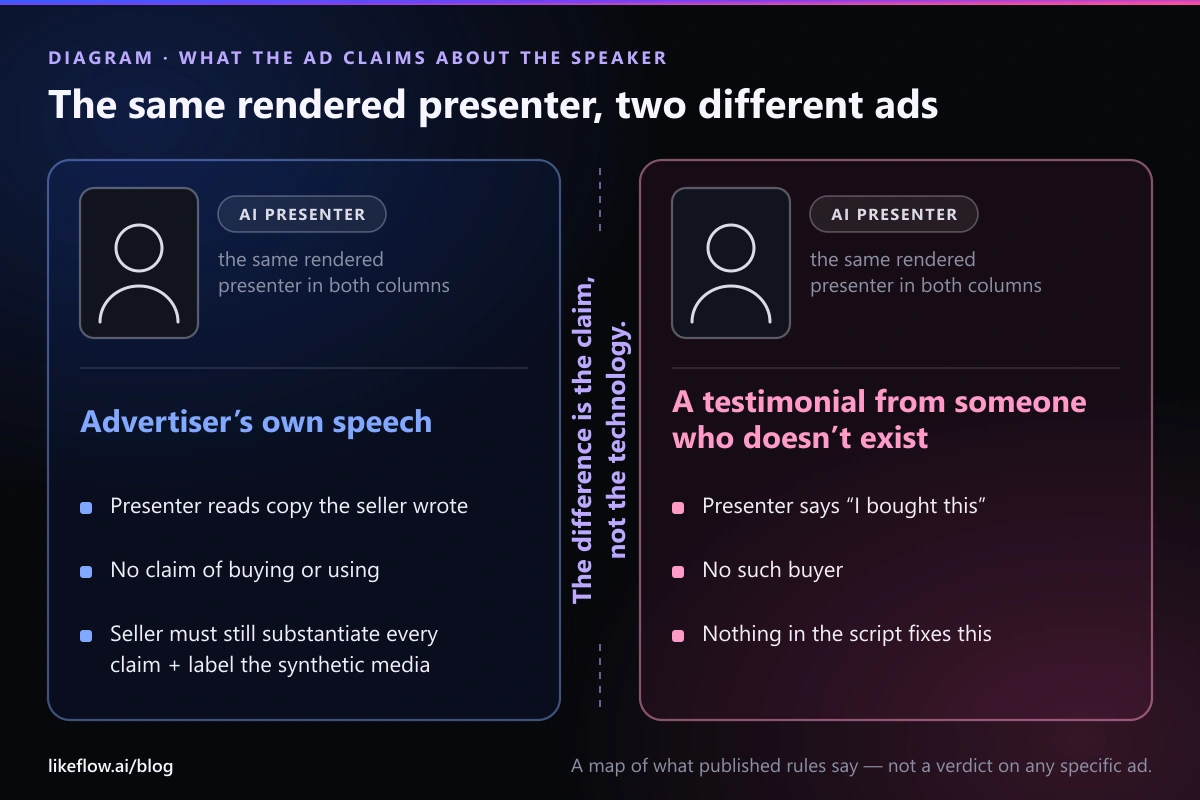
An AI presenter reading your own ad copy is a different thing from an AI person claiming to have bought your product.
Every provision of the Code of Federal Regulations quoted on this page was read in full at the source linked in the footnote and checked September 14, 2026. The FTC press releases and business-guidance pages cited here were read in full at ftc.gov on that date. Two sources did not return their content to us — federalregister.gov and ecfr.gov, which both redirect to a block page — so where this page relies on them it rests on the Legal Information Institute's copy of the same regulation text; the footnote says so and names the sources. LikeFlow, which publishes this page, sells video production software, so treat this as an interested party's reading of published rules rather than as advice. This page is not legal advice and does not tell you that any specific practice of yours is lawful. For that, ask a lawyer who can see your actual creative.
The short version
- The line is not “AI or not AI.” It is who the ad claims to be speaking. The rules attach to the representation a viewer takes away, not to the rendering technology that produced the pixels.
- A synthetic person who claims to have bought your product is the prohibited thing. 16 CFR §465.2(a) reaches a testimonial that materially misrepresents “That the reviewer or testimonialist exists” or “That the reviewer or testimonialist used or otherwise had experience with the product, service, or business that is the subject of the review or testimonial.”
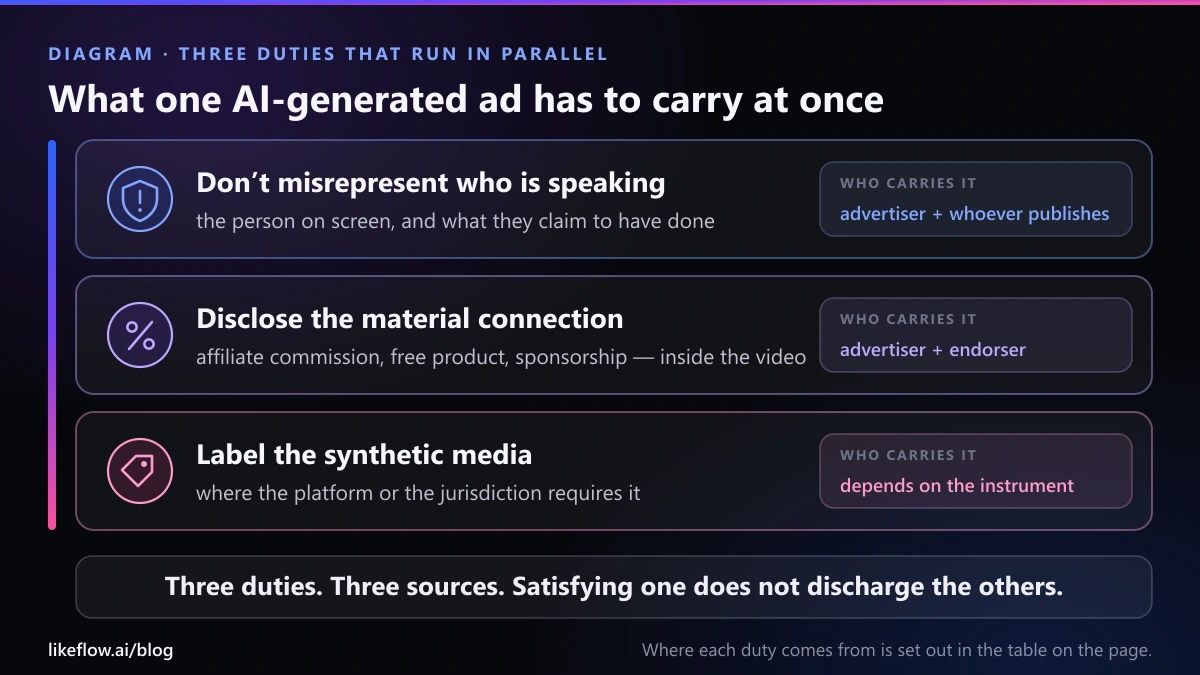
- Three separate duties, three separate sources. Don't misrepresent who is speaking (Part 465 and Section 5). Disclose your material connection, affiliate commissions included (Part 255). Label synthetic media where a platform or a jurisdiction requires it. Satisfying one does not satisfy the others.
- Liability follows dissemination, not just creation. §465.2(b) reaches a business that disseminates, or causes the dissemination of, a testimonial “about the business or one of the products or services it sells” which it “knew or should have known materially misrepresented” who the speaker is. If you are the seller, posting a fabricated testimonial someone else wrote is inside that sentence when you knew or should have known.
- Whether the tool vendor is on the hook is genuinely unsettled. The FTC brought that theory against an AI writing tool in September 2024, obtained an order in December 2024, then reopened and set that order aside on December 22, 2025. The question is open again.
- Two calendars converged on August 2, 2026. EU AI Act Article 50 became applicable, and California's AI Transparency Act became operative, on the same date — with obligations that fall on different parties.
Are AI-generated UGC ads illegal, or only the fabricated ones?
We located no published FTC rule that prohibits AI-generated advertising as such. Part 465 is written entirely in terms of misrepresentation, and the operative sentence names the misrepresentation rather than the production method. Here is §465.2(a), in full:
“It is an unfair or deceptive act or practice and a violation of this part for a business to write, create, or sell a consumer review, consumer testimonial, or celebrity testimonial that materially misrepresents, expressly or by implication: (1) That the reviewer or testimonialist exists; (2) That the reviewer or testimonialist used or otherwise had experience with the product, service, or business that is the subject of the review or testimonial; or (3) The reviewer's or testimonialist's experience with the product, service, or business that is the subject of the review or testimonial.”
Read it twice and the practical test falls out. The rule does not ask what rendered the face. It asks what the ad represents about the person on screen: that they exist, that they used the thing, and what happened when they did. An ad that makes none of those three representations is not addressed by §465.2 at all — which is not the same as saying it is lawful, because everything else in advertising law still applies to it.
| What the ad actually does | How an ordinary viewer reads it | Which published rule is engaged | What still has to be true |
|---|---|---|---|
| AI presenter delivers advertiser-written copy and makes no claim of personal purchase or use | “This seller is telling me about its product, using a synthetic presenter” | General truth-in-advertising duties under Section 5 of the FTC Act; platform synthetic-media labeling policies | Every product claim in the script must be substantiated, and the synthetic nature must be labeled wherever a platform or a jurisdiction requires it |
| AI presenter says “I bought this and it changed my life” | “A real customer is telling me about their own experience” | 16 CFR §465.2(a)(1) and (a)(2) — misrepresenting that the testimonialist exists, and that they used the product | Nothing rescues this pattern. The speaker does not exist, and a disclaimer elsewhere on the page does not unmake the representation in the video |
| A genuine, verifiable customer review is shown on screen, attributed as customer feedback, in the third person | “The seller is reporting something a buyer wrote” | §465.2(a) if the quoted review is fabricated and you wrote, created or sold it; §465.2(b) if you are the seller and disseminated it knowing or having reason to know | The review must be genuine, accurately represented, and not misleading in the context the ad puts it in |
| AI-drafted “reviews” submitted to a marketplace or review platform | “Independent buyers rated this product” | §465.2(a); §465.4 if compensation or incentives were exchanged for reviews expressing a particular sentiment; §465.5 if the writer is an insider | Covered squarely. Nothing about AI authorship changes the analysis compared with a human writing the same fake review |
| A paid human creator appears; AI is used only for editing, captions or b-roll | “A person I follow is recommending this” | 16 CFR Part 255 — the material connection between endorser and seller must be disclosed | The disclosure must be clear and conspicuous and must appear in the video, not only in a bio or a linked page |
What exactly counts as a fake or AI-fabricated testimonial?
A testimonial is defined by the impression it creates, and the definition was drafted broadly enough to catch a rendered human being. §465.1(f) defines a consumer testimonial as:
“an advertising or promotional message (including verbal statements, demonstrations, or depictions of the name, signature, likeness, or other identifying personal characteristics of an individual) that consumers are likely to believe reflects the opinions, beliefs, or experiences of a consumer who has purchased, used, or otherwise had experience with a product, service, or business.”
Two phrases carry the weight. “[D]epictions of the… likeness… of an individual” means a synthetic human on screen is inside the definition's outer boundary. And “consumers are likely to believe” means the definition is not triggered by the avatar's existence but by what the ad leads a viewer to believe about it. A rendered person who says “here are the three specs the seller wants you to know” is not asserting a purchase; a rendered person who says “this arrived Tuesday and I have used it every day since” is.
The Endorsement Guides point the same way from a different angle. 16 CFR §255.0(b) defines an endorsement as “any advertising, marketing, or promotional message for a product that consumers are likely to believe reflects the opinions, beliefs, findings, or experiences of a party other than the sponsoring advertiser,” and says the endorser “could be or appear to be an individual, group, or institution.” The FTC's announcement of the revised Guides on June 29, 2023 described the change as clarifying the extent to which the definition includes fake reviews and virtual influencers.
Are AI-generated presenters permitted, and under what conditions?
We found nothing in the published FTC rules we reviewed that bans a synthetic presenter as such — the exposure comes from what you have the presenter say and whether the video is labeled where labeling is required. Two conditions do most of the work, and neither of them is a safe harbor we can promise you:
- The script must not assert an experience the speaker never had. No “I bought,” no “I tried,” no “this worked for me,” no implied purchase through props, unboxing framing or a delivery box. Implication counts: §465.2(a) reaches misrepresentations made “expressly or by implication.”
- Any product claim must be substantiated by you, before it ships. Moving a claim from your landing page into a presenter's mouth does not change who has to be able to prove it. The AI did not make the claim; you did.
What is genuinely unresolved is the middle ground. A presenter who expresses enthusiasm without asserting purchase — “this is the one I would pick” — is not obviously a testimonial under §465.1(f) and not obviously outside it either, because the test runs on what consumers are likely to believe, and nobody has litigated that question against a rendered presenter as far as our search of published FTC materials could establish. If your creative lives in that middle ground, that is a conversation for counsel rather than for a blog post.
What do I have to disclose, and is an affiliate link a “material connection”?
Yes — an affiliate commission is the textbook material connection, and the disclosure duty is separate from, and additional to, anything about AI. 16 CFR §255.5(a) states the rule directly:
“When there exists a connection between the endorser and the seller of the advertised product that might materially affect the weight or credibility of the endorsement, and that connection is not reasonably expected by the audience, such connection must be disclosed clearly and conspicuously.”
For video, the FTC's business FAQ on the Endorsement Guides is unusually concrete about placement. We read that page at ftc.gov on September 14, 2026; the passages quoted below are the document's own words: “if the endorsement is made through visual means, the disclosure should be made at least visually. If the representation is made audibly, the disclosure should be made at least audibly. And if the representation is made through both visual and audible means, the disclosure should be made both visually and audibly.” The same document warns that “Viewers are more likely to miss a disclosure at the end of the video, especially since some may not watch the whole thing. Having it at the beginning of the review would be better.”
Affiliate programs stack their own contractual requirement on top of the legal one. The Amazon Associates Program Operating Agreement requires that “You must clearly and prominently state the following, or any substantially similar statement previously allowed under this Agreement, on your Site or any other location where Amazon may authorize your display or other use of Program Content: ‘As an Amazon Associate I earn from qualifying purchases.’” That is a contract term, enforced by Amazon; it does not replace the FTC disclosure, and the FTC disclosure does not replace it. If you are building a repeatable posting workflow, the operational side of this is covered in our guide to Amazon affiliate video automation.
| Duty | Where it comes from | What it attaches to | Who the instrument puts it on |
|---|---|---|---|
| Don't misrepresent who is speaking | 16 CFR Part 465, effective October 21, 2024; Section 5 of the FTC Act | The claim the ad makes about the existence and experience of the person on screen | The business that writes, creates or sells it — and, under §465.2(b), a business that disseminates a testimonial about its own products or services knowing or having reason to know |
| Disclose the material connection | 16 CFR Part 255 (§255.5), plus your affiliate program's own contract terms | The relationship between the endorser and the seller, including a commission on a link | Advertiser and endorser both; program terms bind the program participant |
| Label the synthetic media | Platform policies; EU AI Act Article 50, applicable from 2 August 2026; California AI Transparency Act (SB 942), operative 2 August 2026 | The fact that the video was generated or materially altered by AI | Varies by instrument: platforms put it on the uploader, Article 50(4) puts it on the deployer, and SB 942 puts its obligations on covered providers above a stated user threshold |
Do I have to label the video as AI-generated?
Under platform rules, usually yes for realistic content; under US federal law, we could not locate a general labeling mandate for advertising in the FTC materials we reviewed. These are different questions with different answers, and conflating them is how sellers end up either over-confident or needlessly paralyzed.
Platform policy is the layer that bites first, because it is enforced automatically and quickly. YouTube's disclosure requirement, for example, applies to content that “Makes a real person appear to say or do something they didn't do,” “Alters footage of a real event or place,” or “Generates a realistic scene that didn't actually occur,” while exempting things like beauty filters, color adjustment, and what it calls “Production assistance, like using generative AI tools to create or improve a video outline, script, thumbnail, title, or infographic”. Other major video platforms publish their own synthetic-media policies. These policies are revised often; read the current version on the platform you are posting to rather than a summary of it, including this one.
The statutory layer is newer and geographically split. EU AI Act Article 50 became applicable on 2 August 2026. Article 50(2) requires providers of systems that generate synthetic audio, image, video or text to mark outputs “in a machine-readable format and detectable as artificially generated or manipulated,” and Article 50(4) requires deployers of systems that generate deep-fake content to disclose that the content is “artificially generated or manipulated.” On the same date, California's AI Transparency Act (SB 942, as amended by AB 853) became operative, requiring covered generative-AI providers above a stated monthly-user threshold to offer a free AI detection tool, to include a latent disclosure in AI-generated content, and to offer users the option of a manifest disclosure. Note the difference in who is targeted: SB 942 puts its obligations on the provider of the AI system, not on the seller running the ad.
Who is liable — the advertiser, the creator, or the tool vendor?
The advertiser is squarely covered, the disseminator is covered on a knew-or-should-have-known standard, and the tool vendor's position is genuinely unsettled today. Take them in order, because the third one changed recently and most write-ups have not caught up.
The advertiser. §465.2(a) reaches a business that writes, creates or sells the offending testimonial. If the script is yours, you are the business in that sentence.
The disseminator. §465.2(b) extends to a business that purchases a consumer review, or disseminates or causes the dissemination of a consumer testimonial or celebrity testimonial “about the business or one of the products or services it sells,” which the business “knew or should have known materially misrepresented” the same three things. Read the scope clause carefully: the dissemination prohibition is drafted around testimonials about the disseminating business's own products, so whether it reaches an affiliate who does not sell the product is a genuine question, and we located no published FTC application of §465.2(b) to an affiliate. Section 5 of the FTC Act is not drafted that narrowly, and an affiliate who publishes a fabricated testimonial is still the party putting that representation in front of consumers. §465.2(d) carves out two situations from paragraphs (b) and (c) — testimonials that resulted from “generalized solicitations to purchasers to post reviews or testimonials about their experiences with the product, service, or business,” and reviews that appear “as a result of the business merely engaging in consumer review hosting.” Neither carve-out describes an advertiser publishing an ad.
The tool vendor. This is the open question. In September 2024, as part of a sweep the agency called Operation AI Comply, the FTC filed an administrative complaint against Rytr LLC over a “Testimonial & Review” feature, on the theory that supplying subscribers with the means and instrumentalities to produce deceptive testimonials violated Section 5. The Commission approved a final consent order in December 2024 barring the company from advertising, promoting, marketing, or selling any service dedicated to or promoted as generating consumer reviews or testimonials. Then, on December 22, 2025, the FTC issued an order reopening and setting that final order aside, stating that the complaint failed to satisfy the legal requirements of the FTC Act and that the order unduly burdened AI innovation, and citing both the Administration's artificial intelligence executive order and America's AI Action Plan.
So the only US enforcement action we located that squarely tested tool-vendor liability for AI-generated testimonials no longer stands: the agency that brought it reopened and set the order aside. That does not make tool-vendor liability impossible; it means there is currently no live federal precedent establishing it, and it means the burden sits even more plainly on the person who publishes the ad. Do not read a set-aside order as permission.
What are the penalties?
Violations of a trade regulation rule such as Part 465 expose a business to civil penalties where it acted with actual knowledge, or knowledge fairly implied on the basis of objective circumstances, that the conduct was prohibited, and the maximum published in 16 CFR 1.98 is $53,088 per violation for penalties assessed after January 17, 2025. That figure is adjusted for inflation periodically, so verify the current amount before relying on it; it was the amount in force when we checked on September 14, 2026.
Enforcement under this rule is young. On December 22, 2025 the FTC sent warning letters to ten companies about possible violations of the Consumer Review Rule. The agency publishes the letter template it used. That template leaves the specific-conduct paragraph blank and supplies one worked example: “providing compensation to your employees in exchange for the employee obtaining 5-star reviews from friends and family, and obtaining reviews from individuals who did not have actual experience with the company's products or services.” That sentence is an illustration printed in a form letter, not a finding about any particular recipient. Warning letters are not findings of violation, and the recipients were not named publicly.
We could not locate, in the published FTC materials we reviewed on September 14, 2026, a completed enforcement action applying §465.2's fake-testimonial provisions to an AI-generated presenter appearing in an advertisement. Nor could we locate published guidance on how the Commission would count “violations” across a video campaign — whether per video, per placement, or per impression. Anyone quoting you a total exposure figure for a hundred posts is multiplying, not citing.
Where are the rules genuinely unsettled?
In at least six places, and saying so is more useful than pretending otherwise. Each of these is a question we could not answer from primary sources as of September 14, 2026:
- Tool-vendor liability. The means-and-instrumentalities theory was asserted in 2024 and abandoned in December 2025. Nothing has replaced it.
- Whether §465.2(b) reaches an affiliate who does not sell the product. The dissemination prohibition is drafted around a testimonial “about the business or one of the products or services it sells,” and we located no published FTC application of that clause to an affiliate who earns a commission on a sale made by someone else.
- The enthusiastic-but-not-asserting presenter. Whether a synthetic spokesperson who praises a product without claiming to have bought it is a “consumer testimonial” turns on what consumers are likely to believe, and we found no published FTC application of that test to a rendered presenter.
- How violations are counted. See above. The per-violation maximum is published; the unit of violation for video advertising is not, as far as our search established.
- Whether a federal AI label is required for advertising. Platform policies clearly require one for realistic synthetic content. We could not locate a general federal advertising-labeling mandate in the FTC materials we reviewed — which is not the same as concluding that no disclosure duty could arise under Section 5 on particular facts.
- Reach of the EU rules over a US seller. Article 50 obligations attach to providers and deployers of AI systems; how they apply to a US-based seller whose video is distributed into the EU by a platform is not something we can resolve here, and it is a live question for anyone selling cross-border.
A practical checklist for an AI-generated product ad
Not legal advice, and not a compliance guarantee — a list of questions the published rules will make you answer. If you cannot answer one of them about a video sitting in your drafts folder, that is the video to look at first.
- Does anyone on screen state or imply that they personally bought, received or used the product? If yes, can you name the real person who did?
- Does the framing imply purchase even without words — an unboxing, a delivery box, a worn item, “my” anything?
- Can you substantiate every product claim in the script, on its own, without reference to who says it?
- If a customer's words appear, are they genuine, accurately quoted, attributed as customer feedback, and not misleading in the context you placed them in?
- Is your material connection — affiliate commission, free product, sponsorship — disclosed clearly and conspicuously inside the video, in both the visual and audible channel where the endorsement uses both?
- Have you applied the AI label the destination platform requires, under that platform's current policy rather than last year's?
- If your ad reaches EU viewers, have you taken advice on Article 50 rather than assuming it is somebody else's problem?
- Do you keep a record of the final script, the disclosure, and the date you published? The knew-or-should-have-known standard rewards people who can show their process.
Where LikeFlow sits — and what this page is not
LikeFlow is video production software, and on the questions above it is a tool, not a shield. You paste a product link, the tool drafts a script, you edit it line by line, and it renders a 1080×1920 vertical MP4 with a presenter chosen from a fixed library. Free access is 5 credits with no card. Starter is $29 for 100 credits, and 1 credit is one 30-second video — ≈$0.29 per 30-second video on Starter by our own arithmetic ($29 ÷ 100). A presenter-led UGC video costs 5 credits. Credits are monthly and do not roll over. These figures apply the two published rules only — 1 credit for a 30-second video, 5 for a UGC review video. Editing actions inside the product carry their own credit costs, shown on the button before you spend them, so the figure above is the best case those two rules allow, not a forecast of a working month.
The part that matters for this page's subject is simple and unglamorous: you approve the script before anything renders, and you are the advertiser. That is exactly the position every rule quoted above puts you in. The tool changes what production costs. It does not change who is answerable for the words.
What LikeFlow does not and cannot do:
- It does not decide whether your claims are substantiated. That judgment is yours before you publish.
- It does not write or place your material-connection disclosure. No tool of any kind can disclose on your behalf.
- It does not apply a platform's AI label. There is no auto-posting or scheduling — you download the MP4 and publish it yourself, which means the label is yours to add.
- It does not dub or translate an existing video. Nothing in the video is built from your face or your voice. The presenter library is fixed and you choose from it.
- It does not give legal advice, and neither does this page. Nothing here establishes that any particular ad of yours is lawful.