
HeyGen does make UGC-style ads: it publishes a dedicated UGC ad page and an avatar library. The difference is the unit you buy. HeyGen's Creator plan is $29/month for 600 credits ($24/month billed annually), spent per minute of avatar render at 4 to 48 credits a minute depending on the model. LikeFlow's Starter is $29 for 100 credits, and one credit is one finished 30-second video. Checked September 29, 2026.
Every HeyGen figure below was read on HeyGen's own pages on September 29, 2026; sources are in the footnote. Disclosure: this page is published by LikeFlow, which sells a competing product. That is exactly why the cost table shows the HeyGen configurations that come out cheaper than ours, and why there is a section on what LikeFlow does not do.
The short version
- HeyGen is a real UGC ad tool, and any page that tells you otherwise is easy to disprove. It ships a UGC video ads product page, an avatar library and a URL-to-video tool. If someone tells you HeyGen is not for UGC, check the site.
- The two tools price different things. HeyGen bills per minute of avatar render — 4 to 48 credits a minute depending on which avatar model you pick. LikeFlow bills one credit per finished 30-second video, five if it has a presenter. Both entry plans cost $29/month ($24 if HeyGen is billed annually), checked September 29, 2026.
- On HeyGen's cheaper avatar models, a 30-second clip is cheaper than ours. By our arithmetic a 30-second Avatar III clip works out to roughly ≈$0.10 to ≈$0.17 on the Creator plan billed monthly, or ≈$0.08 to ≈$0.14 billed annually, against ≈$0.29 and ≈$1.45 on LikeFlow's $29/mo Starter plan, by the same kind of division. We are not going to hide that.
- The number moves about 12x depending on a dropdown. The same 30 seconds costs about 2 credits on Avatar III Video Look and about 24 on Avatar V. Which model you ship on is the price, and that variable does not exist on LikeFlow's side.
- HeyGen also wins on rollover, API and video length. Its unused monthly credits roll over one more month; LikeFlow's do not. It documents bulk generation through its API; LikeFlow's self-serve app is one product at a time. Its individual and Business plans are listed at 30 to 60 minutes per video; LikeFlow makes 30-second clips only.
What are HeyGen's plans and prices?
Its entry paid plan is Creator at $29/month, or $24/month billed annually, for 600 credits; Pro starts at $49 and Business is $149 with additional seats at $20 per seat per month.
HeyGen publishes its prices openly, which made this comparison far easier to write than our Arcads and Creatify pricing breakdowns were. Here is what its pricing page said, quoted from the FAQ block on that page.
| Plan | Price as published | Credits per month | What the page states |
|---|---|---|---|
| Free | $0 | Not stated as credits | Up to 3 videos a month, no credit card required; videos up to 1 minute |
| Creator | $29/month, or $24/month if you pay annually | 600 | Aimed at solo creators; videos up to 30 minutes |
| Pro | Starts at $49/month | 1,000 at the entry tier | Scales up to tiers with more credits per month; videos up to 30 minutes |
| Business | $149/month, additional seats $20/seat/month | 1,500 | For teams creating and collaborating; videos up to 60 minutes |
| Enterprise | Contact sales | Custom | Contact sales; details not confirmed across our reads |
Two notes before the arithmetic. First, $29 is the monthly-billing price and $24 is the same plan billed annually — quoting only the higher number would inflate what HeyGen actually charges, so both appear everywhere on this page. Second, the site is geo-localized: it served us its Vietnamese rendering on one hostname and its English rendering on another, with prices in US dollars on both.
How much does one HeyGen UGC ad cost?
Roughly ≈$0.10 to ≈$1.16 for 30 seconds on the Creator plan billed monthly, or ≈$0.08 to ≈$0.96 billed annually, depending on the avatar model — and which end you land on is decided by a dropdown, not by your budget. HeyGen's help center publishes a credit rate per avatar model, per minute. Those rates are the whole story.
| Avatar model (HeyGen's published rate) | Credits for 30 seconds | Clips from 600 credits | Cost per clip at $29/mo | At $24/mo billed annually |
|---|---|---|---|---|
| Avatar III Video Look — 4 credits/minute | 2 | 300 | ≈$0.10 | ≈$0.08 |
| Avatar III Photo Look — 7 credits/minute | 3.5 | ≈171 | ≈$0.17 | ≈$0.14 |
| Avatar IV Photo Look — 16 credits/minute | 8 | 75 | ≈$0.39 | ≈$0.32 |
| Avatar IV Video Look — 31 credits/minute | 15.5 | ≈38 | ≈$0.75 | ≈$0.62 |
| Avatar V Photo or Video Look — 48 credits/minute | 24 | 25 | ≈$1.16 | ≈$0.96 |
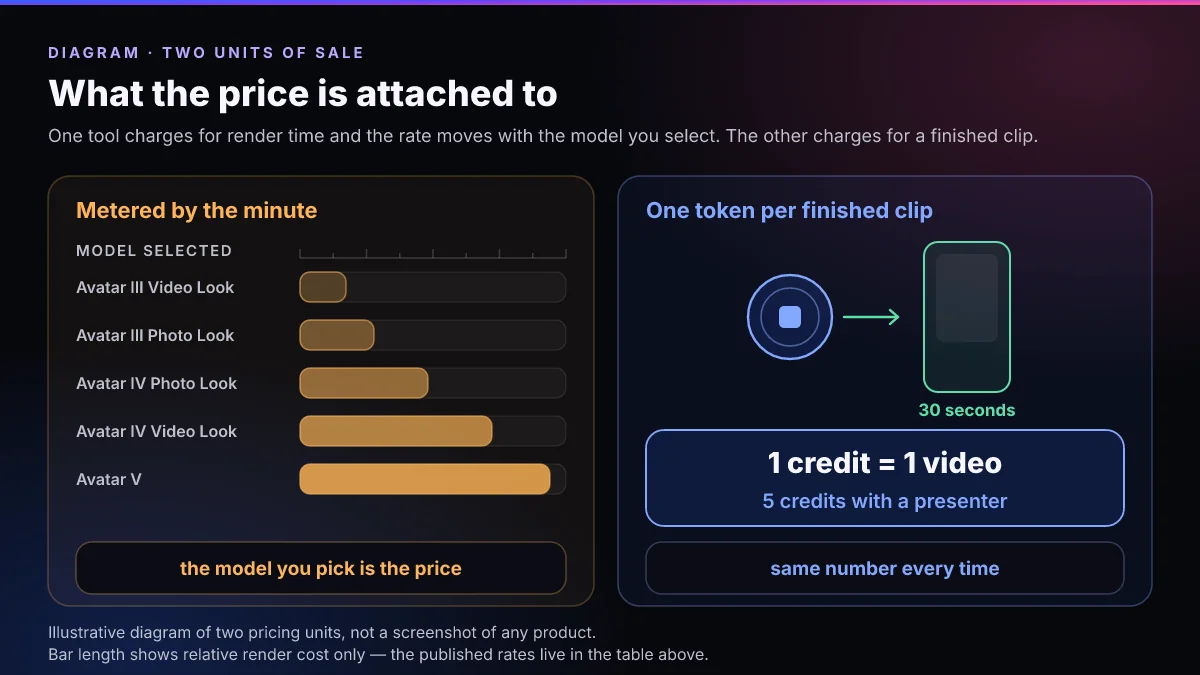
Three things follow, and one of them is uncomfortable for us.
The uncomfortable one first: on HeyGen's older avatar models, a 30-second clip is cheaper than ours. About ≈$0.10 to ≈$0.17 against LikeFlow's ≈$0.29 for a standard 30-second video on the $29/mo Starter plan, and far below our ≈$1.45 for a video with a presenter on that same plan. Both of those LikeFlow figures are our own division of published plan prices. If cost per avatar clip is the only thing you are optimizing, and Avatar III output is good enough for your ads, HeyGen at $24/month billed annually is the cheaper machine. We would rather you read that here than discover it after signing up with us.
Two rates are published; they are not the only rates LikeFlow charges. The published rules — 1 credit for a 30-second video, 5 for a UGC review video — are the rules this page divides by. Editing actions inside LikeFlow carry their own credit costs, each shown on the button that spends them before you click it. Those costs are not on the pricing page, so any video count or per-video figure on this page is the best case those two published rules allow, not a forecast of a working month.
The number moves about 12x on a dropdown. Two credits on one model, 24 on another, for the same 30 seconds. That is a reasonable design — newer models cost more to run — but it means the question of what a HeyGen video costs has no answer until you have decided which avatar model you are shipping on, and you may not know that on day one.
Your monthly ceiling moves with it. The same 600 credits are 300 clips or 25 clips. A budget built on the top row and a campaign shot on the bottom row are off by an order of magnitude.
HeyGen also documents an API route: its URL-to-video page, read September 29, 2026, describes sending a list of pages through the HeyGen API to generate videos in bulk, and quotes API video generation at $0.05 per second with a $5 minimum deposit. At that rate a 30-second clip is ≈$1.50 — our arithmetic — so the API is a scaling mechanism rather than a discount.
Is HeyGen actually a UGC ad tool?
Yes, and this is the part most competitor comparisons get wrong. HeyGen ships a UGC video ads product page, an avatar library marketed for creator-style delivery, and a URL-to-video tool. Reading its UGC video ads page on September 29, 2026, HeyGen describes a three-step flow — enter an ad script, either your own or one from its AI script generator, then pick an AI avatar and background, then generate — with a stated turnaround of two to three minutes per video. The same page states output in 9:16 (1080×1920), 1:1 (1080×1080) and 16:9 (1920×1080) plus custom sizes, support for 175+ languages with voice cloning and lip-sync, and a variation workflow it describes as generating ten variants testing hooks and another ten testing calls to action.
We read that page once, through an automatic translation, so treat those details as HeyGen's claims read on a single visit rather than as things we tested. But the direction is not in doubt: HeyGen sells UGC ad creation deliberately and documents it in detail. A comparison page that tells you otherwise is out of date.
The honest distinction is narrower and more useful: HeyGen's UGC flow starts from a script, not from a product listing. Its own three steps begin with the ad script — you paste your own, or you use the AI script generator its page describes as trained on high-performing UGC ad formulas. Either way the input is copy. That is the right design for a performance marketer who already knows the hook they want to test, and the wrong shape for someone holding fifty product links and no copy.
Can HeyGen start from a product link?
Partly, through a separate tool, and the specifics matter if your links are Amazon links. HeyGen publishes a URL-to-video tool that says it turns any URL into a finished, on-brand video: extracting the content, drafting a script, building a storyboard, then adding voice-over, subtitles and music. The examples that page names are blog posts, landing pages, case studies, help-center articles, and Shopify and Etsy product links.
Read on September 29, 2026, we did not find Amazon named anywhere on that page, and we have not tested an Amazon URL in HeyGen ourselves — so read that as an absence on their page on one date, not as a limitation we verified. LikeFlow's flow runs the other way around: you paste a product link from Amazon, Shopee or TikTok Shop, and the script is drafted from what the tool finds on that listing. The wider map of how affiliates wire these pipelines together is in our guide to Amazon affiliate video automation.
Where the two stop being the same purchase
Two rates are published; they are not the only rates LikeFlow charges. The published rules — 1 credit for a 30-second video, 5 for a UGC review video — are the rules this page divides by. Editing actions inside LikeFlow carry their own credit costs, each shown on the button that spends them before you click it. Those costs are not on the pricing page, so any video count or per-video figure on this page is the best case those two published rules allow, not a forecast of a working month.
| What we asked | HeyGen | LikeFlow |
|---|---|---|
| Entry paid plan | $29/month Creator, 600 credits ($24/month billed annually) | $29/month Starter, 100 credits |
| What one credit buys | Varies: 4–48 credits per minute of avatar render, by model | One finished 30-second video; 5 credits for a UGC review video with a presenter |
| A 30-second clip | ≈$0.08–$1.16 depending on model and billing term | ≈$0.29 standard, ≈$1.45 with a presenter — our arithmetic on the $29/mo Starter plan |
| Where the script starts | A script you supply, or one from HeyGen's AI script generator; a separate URL-to-video tool can draft one from a link | Drafted from the product link you paste (Amazon, Shopee, TikTok Shop) |
| Free tier | 3 videos a month, no credit card required | 5 credits, no card — 5 standard videos, or 1 with a presenter |
| Unused credits | Roll over one more month on monthly plans; accumulate to renewal on annual | No rollover; plan credits are allocated monthly |
| Aspect ratios | 9:16, 1:1, 16:9 and custom, per its UGC ads page | 1080×1920 vertical only |
| A presenter built from your own face or voice | Sold | Not sold. You choose from a fixed presenter library; nothing in it is built from you. |
| Many different products at once | Documented through the HeyGen API, sending a list of pages | One product at a time in the app; no public API and no self-serve bulk import |
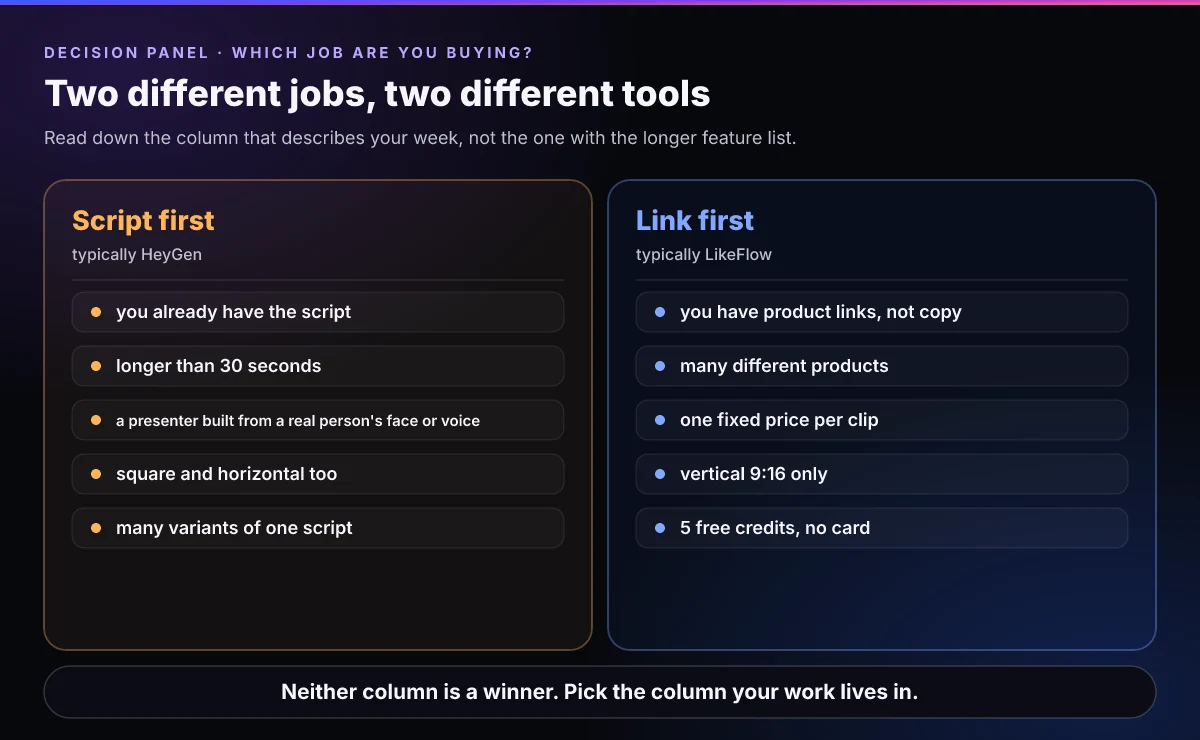
One row deserves a paragraph, because it is the row most likely to change your answer. LikeFlow's in-app language picker lists 646 selectable output languages, a count we verified by counting the entries in LikeFlow's own source on September 29, 2026 — likeflow.ai does not publish this number, so the code is the source of truth, not our marketing. Read the limits before treating it as a promise: the list uses generic language codes with no regional variants — one Portuguese, one Spanish, not Brazilian versus European, not Mexican versus Castilian — we have not independently verified the rendered audio in any of those languages, and it is a language you select for a script and its voice-over, not dubbing or translation. The two counts are not measured the same way: ours is a count of entries in our own code, and HeyGen's is a claim on its marketing page. HeyGen's UGC ads page states 175+ languages with voice cloning.
Who should stay with HeyGen
If any of these describe you, this page is not an argument to switch:
- You write your own scripts and want a performer to deliver them. That is the flow HeyGen is built around, and it is a good one.
- You need a cloned voice or a custom avatar of a specific person. HeyGen's pricing page lists Custom Video Avatars and Voice Cloning as plan features, read September 29, 2026. LikeFlow does not sell a presenter built from a specific person, and the app gives you no way to make your own face or your own voice the presenter — so no price advantage here substitutes for something we do not sell.
- You need videos longer than 30 seconds. HeyGen prices avatar work by the minute, and its pricing page lists a maximum video length of one minute on the free plan, 30 minutes on Creator and Pro, and 60 minutes on Business, above which it lists only Enterprise. LikeFlow's unit is a 30-second vertical clip and nothing longer.
- You need square or horizontal as well as vertical. LikeFlow exports 1080×1920 and only that.
- You want to drive generation from an API, or run many pages through it unattended. HeyGen documents that route; LikeFlow's commercial app does not have one.
- Your bottleneck is variants of one script, not the number of products. Testing ten hooks and ten calls to action from one script is HeyGen's home ground.
What LikeFlow does not do
The list we would want if we were the buyer:
- The presenter is not you. You pick from a fixed presenter library, and the app gives you no way to make your own face or your own voice the presenter: the picker lists library presenters only, and the reference-video pipeline rejects any instruction to reuse the identity of a person from your reference clip — both verified in LikeFlow's own source on September 29, 2026, not on our marketing pages. The library ships with the first 3 entries unlocked for every account, paid plans included.
- No dubbing and no translation. The 646-language figure is the language you can select for a script and its voice-over. LikeFlow cannot take a video you already have and re-voice it.
- No auto-posting. It renders a 1080×1920 MP4. Uploading it, applying the platform's AI label and writing your affiliate disclosure are all yours.
- No public API and no A/B testing. Everything runs in the app UI, one video at a time. We make videos; we do not buy media and we do not report on ad performance.
- Credits do not roll over. They are allocated monthly and reset each cycle. That is a straight loss against HeyGen, which rolls unused monthly credits forward one month.
- 30-second vertical videos only. Not long-form, not landscape.
- The script starts from the listing you paste, not from a brief you write. A listing with thin content produces a thin video, and you should read every script before you render it.
Frequently asked questions
Is HeyGen good for UGC ads?
Yes — HeyGen publishes a UGC video ads product page, an avatar library marketed for creator-style delivery, and a URL-to-video tool. Read on September 29, 2026, that page describes a three-step flow — write the ad script, pick an avatar and background, generate — with a stated turnaround of two to three minutes, output in 9:16, 1:1 and 16:9, and a workflow for generating variations of one script. The main thing to know before buying is that the flow starts from a script — your own or one from HeyGen's AI script generator — rather than from a product listing URL.
How much does one HeyGen video cost?
It depends on the avatar model, because HeyGen bills per minute of render. Its help center published rates from 4 credits a minute for Avatar III Video Look up to 48 credits a minute for Avatar V, read on September 29, 2026. On the Creator plan — $29/month, or $24/month billed annually, for 600 credits — that works out by our arithmetic to roughly ≈$0.10 to ≈$1.16 for a 30-second clip, or ≈$0.08 to ≈$0.96 at the annual rate. We found no published rule for how sub-minute videos are billed, so those figures halve the per-minute rate; if HeyGen charges a one-minute minimum, double them.
Does HeyGen have a free plan?
Yes. The FAQ on HeyGen's own pricing page, read on September 29, 2026, states that you can use HeyGen for free and generate up to 3 videos a month with no credit card required, and the free plan card caps video length at one minute. For comparison, LikeFlow's free tier is 5 credits with no card, which is 5 standard 30-second videos or one video with a presenter.
Two rates are published; they are not the only rates LikeFlow charges. The published rules — 1 credit for a 30-second video, 5 for a UGC review video — are the rules this page divides by. Editing actions inside LikeFlow carry their own credit costs, each shown on the button that spends them before you click it. Those costs are not on the pricing page, so any video count or per-video figure on this page is the best case those two published rules allow, not a forecast of a working month.
Do HeyGen credits roll over?
Yes, within limits. HeyGen's pricing FAQ, read on September 29, 2026, states that monthly subscribers' unused credits roll over for one more month, that annual subscribers' credits accumulate until their annual renewal date, and that credits do not carry over after cancellation. This is one place HeyGen is plainly better than LikeFlow, whose plan credits are allocated monthly and do not roll over.
Can HeyGen turn an Amazon product link into a video?
HeyGen's URL-to-video page says the tool turns any URL into a video, and the product links it names as examples are Shopify and Etsy. Read on September 29, 2026, we did not find Amazon named on that page, and we have not tested an Amazon URL in HeyGen ourselves — so treat this as what their page did and did not say on one date, not as a limit we verified. LikeFlow's create flow takes product links from Amazon, Shopee and TikTok Shop and drafts the script from the listing.
What is a cheaper alternative to HeyGen for high-volume product videos?
It depends what you are making, and honesty requires saying that HeyGen is not expensive per clip on its older avatar models — by our arithmetic a 30-second Avatar III clip is around ≈$0.10 to ≈$0.17 on the Creator plan billed monthly, or ≈$0.08 to ≈$0.14 billed annually, cheaper than LikeFlow's ≈$0.29 on the $29/mo Starter plan, which is our arithmetic too. Where LikeFlow gets cheaper is volume of different products at a fixed unit price: $29 buys 100 credits and one credit is one finished 30-second video, with no model tier changing that number. The free tier is 5 credits and no card. Figures checked September 29, 2026.
Two rates are published; they are not the only rates LikeFlow charges. The published rules — 1 credit for a 30-second video, 5 for a UGC review video — are the rules this page divides by. Editing actions inside LikeFlow carry their own credit costs, each shown on the button that spends them before you click it. Those costs are not on the pricing page, so any video count or per-video figure on this page is the best case those two published rules allow, not a forecast of a working month.
Price a clip before you price a plan
Paste a product link, watch it become a 30-second vertical video, and see the credit cost on screen before you spend one.
Start Creating Free No credit card required. 5 free credits on signup — your first video in minutes.Related reading: Amazon Affiliate Video Automation · Arcads Pricing Explained · Creatify Pricing Explained · Creatify Alternative · All articles