
Topview prices video by model, by resolution, and by four-second clip, not by finished video, so its plans never show a 30-second video's cost. By our arithmetic on September 25, 2026, a 30-second video at Seedance 2.5 in 720p is about 45 credits — roughly $9 on the Pro plan, whose 960-credit annual pool covers about 21 a year. LikeFlow charges 1 credit per finished 30-second video, 100 for $29.
All Topview figures on this page were read off Topview's own public pages on September 25, 2026, and are quoted with the wording they use; sources with URLs are in the footnote. Disclosure: this page is published by LikeFlow, which sells a competing product-video tool. We have tried to earn the comparison — every Topview number here is theirs, every conversion is labelled as our arithmetic, and there is a section below on where Topview is the better buy.
The short version
- The unit of pricing is not a 30-second video. Topview's published credit table prices a four-second clip at a given resolution on a given model, and the rate changes with the plan you are on. In the Pro column on September 25, 2026, Seedance 2.5 at 720p was 6 credits per 4 seconds and 1080p was 14.8, with no discount badge in that column — the 20% OFF printed on that row applied to the Business, Ultra and Team columns. The table does print a video count — 160 at 720p on Pro — but a "video" there is one four-second clip.
- We found no free plan on their pricing page. When we loaded it on September 25, 2026, there was no Free tier, no signup credit allowance and no free-trial offer listed. Their AI UGC page separately mentions "available free credits or trial options" without naming an amount.
- The advertised price matches the Ultra plan's rate — the cheapest per-credit rate on the page. On September 25, 2026 the homepage advertised Seedance 2.5 at "$3.6 / 30s." The pricing page we fetched the same day charges that rate in the Ultra column — 4.8 credits per 4 seconds at 720p, which at Ultra's ≈$0.10 a credit is ≈$3.60 for 30 seconds by our arithmetic. On the entry Pro plan the same 30 seconds is ≈$9.00.
- The entry plan is sold monthly or annually; every credit figure below is the annual one. The pricing page carries a "Monthly / Annually" toggle. On Annually, Pro read "$29 $16 per month, billed annually" and carried 960 credits for the year. A month-to-month option exists: the toggle is there, and Topview's own FAQ describes billing "monthly or yearly" and says credits "reset yearly for annual plans and monthly for monthly plans." We are not quoting a monthly price here, because the monthly card's wording did not read back the same way on every fetch. Topview's FAQ also states that unused credits "don't roll over to the next month." Checked September 25, 2026.
- LikeFlow's answer is deliberately boring. 1 credit = one finished 30-second video. $29 buys 100 of them. A presenter-led UGC version costs 5 credits. The free tier is 5 credits with no card. You can work out your cost per video before you pay, which is the entire point of this page.
What is Topview today?
It is broader than it was. As of September 25, 2026, Topview's homepage headline is "Create Any Video, Just Tell Your Agent" and it describes itself as "The Smartest AI Video Agent" for short films and marketing videos, with tooling named Canvas, Drama Studio, Board and 3D Shot Composer.
That matters for anyone landing here from a comparison search, because it changes what you are comparing against. Topview has not dropped e-commerce — the same site still carries "UGC-Style Ads," "URL to Marketing and Ad Video," "Product Avatar" and "Product Photography," and its product-video page still accepts an Amazon or Shopify URL, a product image, or a written brief. But e-commerce is now one branch of a general-purpose agent rather than the whole product.
The pricing follows the product. An agent that can call Seedance, Wan, Kling, MiniMax and Veo needs a price per model, and a price per model needs a price per second, and a price per second needs a credit. That chain is a defensible design decision. It also means the number you actually want — dollars per finished video — is three conversions away from anything they print.
What does one Topview credit cost?
Between about $0.10 and $0.20, depending on which plan you buy — and Topview does not publish that number, so the last column below is our division.
| Plan (as displayed, billed annually) | Price as shown | Credits included | When the pool resets | Cost per credit (our arithmetic) |
|---|---|---|---|---|
| Pro | "$29 $16 per month, billed annually" — $192/year | 960 per year | Annually, granted upfront | ≈$0.20 |
| Business | "$75 $44 per month, billed annually" — $528/year | 3,000 per year | Annually, granted upfront | ≈$0.176 |
| Ultra | "$150 $50 per month, billed annually" — "$599.9" per year as printed (our arithmetic makes $50 × 12 = $600) | 500 per month | Monthly | ≈$0.10 |
| Team | "$180 $56 per seat/mo, billed annually" — $672/seat/year | 500 per seat per month | Monthly | ≈$0.112 |
| Enterprise | Custom, contact sales | Not published | Not published | Not calculable |
Two structural notes before the interesting table. First, on the annual view the entry plan's credits are one annual pool — 960 credits granted upfront for twelve months, which is 80 credits a month if you spend evenly and nothing at all if you spend them in January. Second, Topview's own FAQ says "Unused credits don't roll over to the next month," while a separate answer on the same page says unused credits do carry over "if you upgrade your plan or switch from a monthly to an annual subscription." Read both before you plan a budget around either.
How many videos does a Topview credit buy?
This is the table the category avoids printing, so here it is. Topview's pricing page publishes a credit cost per four-second clip for each model and resolution; a 30-second video is 7.5 of those clips. That multiplication is our assumption and we state it plainly — Topview does not publish a 30-second price, and if its agent stitches clips differently the figure moves. It moves in units of their four-second clip price, which is the point.
| Model and resolution | Topview's published cost per clip (Pro column) | Credits for 30 seconds (our arithmetic) | Cost on Pro at ≈$0.20/credit | 30-second videos from Pro's 960-credit year |
|---|---|---|---|---|
| Seedance 2.5 — 1080p | 14.8 credits / 4s (no badge in the Pro column) | 111 | ≈$22.20 | ≈8 |
| Seedance 2.5 — 720p | 6 credits / 4s | 45 | ≈$9.00 | ≈21 |
| Seedance 2.5 — 480p | 2.8 credits / 4s | 21 | ≈$4.20 | ≈45 |
| Seedance 2.0 — 720p | 4 credits / 4s | 30 | ≈$6.00 | 32 |
| Seedance 2.0 Mini — 720p | 2.08 credits / 4s (2.6 struck through, 20% OFF badge) | 15.6 | ≈$3.12 | ≈61 |
| Wan 3.0 — 1080p | 4 credits / 4s | 30 | ≈$6.00 | 32 |
| Wan 3.0 — 720p | 1.6 credits / 4s (2 struck through, 20% OFF badge) | 12 | ≈$2.40 | 80 |
| MiniMax H3 — 768p | 1.2 credits / 4s (2 struck through, 40% OFF badge) | 9 | ≈$1.80 | ≈106 |
| Google Veo 3.1 Fast, with audio — resolution not stated | 3.6 credits / 4s | 27 | ≈$5.40 | ≈35 |
| Google Veo 3.1 Fast 4K, with audio | 8 credits / 4s | 60 | ≈$12.00 | 16 |
| Kling 2.6, with audio — 1080p | 3.25 credits / 5s | 19.5 | ≈$3.90 | ≈49 |
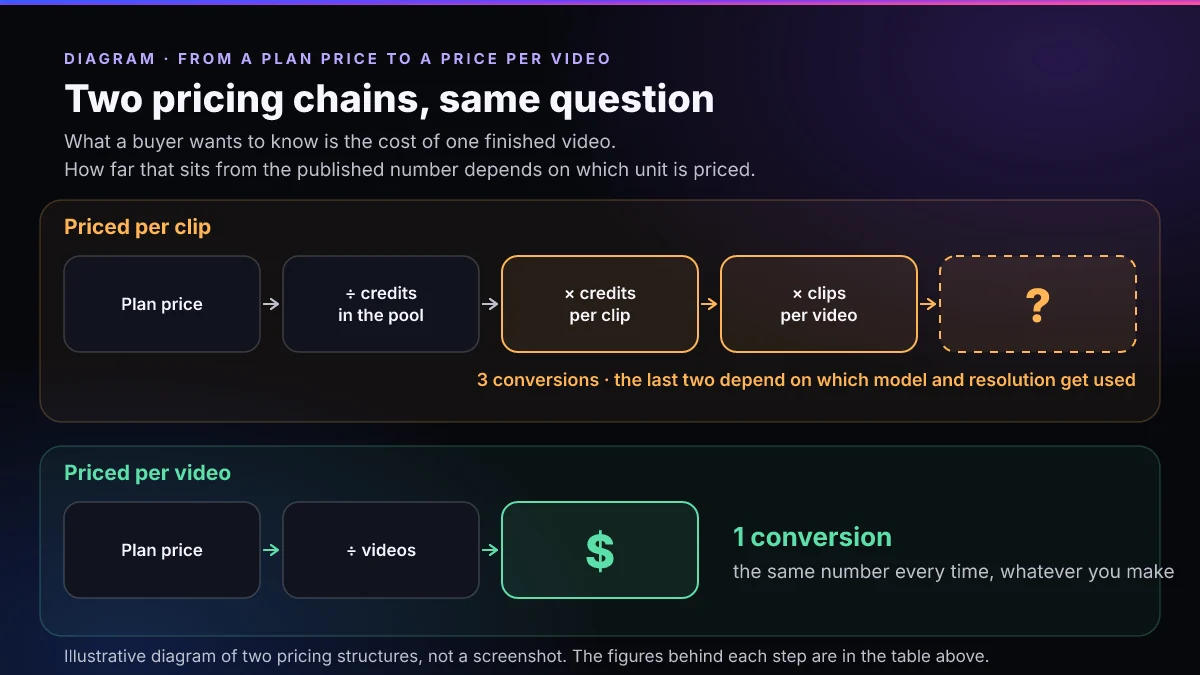
The spread is the finding. On the same $192 annual plan, the same 30-second video costs anywhere from about $1.80 to about $22.20 depending on which model and resolution the agent picks — a spread of about 12.3× by our arithmetic. That is not a criticism of the engineering; a 1080p Seedance render genuinely costs more to produce than a 768p MiniMax one. It is a criticism of budgeting: you cannot forecast a month of content when the unit price is set by a routing decision made after you press go.
And read the last column slowly. At Seedance 2.5 in 720p — the model Topview's own homepage promotes as its flagship — the entry plan's twelve-month credit pool covers roughly 21 thirty-second videos. Not per month. Per year.
Topview's own table prints a much larger number in that same cell: 160 videos. Both are right, and the difference is the whole subject of this page. Its 960 credits divided by 6 credits per four-second clip is 160 — of four-second videos. Divided by the 45 credits a 30-second video takes, it is 21. Nothing on the page is wrong; the unit is just not the one you are shopping for.
Why is Topview's advertised price $3.60 and this table's $9.00?
Because they are two different plans. This one does reconcile, and we would rather show you the reconciliation than leave it looking like a contradiction.
On September 25, 2026, Topview's homepage advertised Seedance 2.5 at "$3.6 / 30s." The pricing page we fetched the same day prices that model differently in each plan column: at 720p, the Pro column showed 6 credits per 4 seconds and the Ultra and Team columns showed 4.8 with a "20% OFF" badge. Our arithmetic: 30 seconds is 7.5 four-second clips, so 36 credits on Ultra; Ultra's "$599.9" a year buys 6,000 credits, which is ≈$0.10 each; 36 credits at ≈$0.10 is ≈$3.60 — the Ultra credit rate, to the cent. We will not call that the only possible reading, because the same banner also advertises Ultra's Unlimited bundle; but the arithmetic match is exact, and both readings point at the same plan.
What matters for a buyer is which plan that rate belongs to, and in the banner we fetched it sat on its own. Ultra is displayed as "$150 $50 per month, billed annually," printed as "$599.9" for the year. On the Pro plan at $192 a year, the same model at the same resolution is ≈45 credits for 30 seconds, or ≈$9.00 by our arithmetic — two and a half times the advertised number. The cheapest Seedance 2.5 row available in the Pro column is 480p at ≈$4.20, which is still above $3.60. So the advertised price is real; it is just not a price the entry plan can reach at any resolution.
The same homepage string bundles the figure with "60-Day Unlimited | 365-Day Unlimited," and the pricing page we fetched the same day does explain those windows. Its FAQ says "Unlimited lets you generate content without spending credits on supported models, resolutions, or quality tiers included in your plan," and that the "365 Unlimited promo gives you one year of unlimited generations on the specific models and specific resolutions listed in each plan's card." They are not priced separately, then: they come with the plan, and each card lists its own models. That matters for the table above. None of the three models on the Pro card's Unlimited lines — Nano Banana 2, Nano Banana Pro, Seedream 5.0 — is one of the video models the credit table prices, so on Pro every row in our table is still paid for in credits. The Ultra and Team cards are different: they list Seedance 2.5, Seedance 2.0, Seedance 2.0 Mini and Wan 3.0 at 720p, plus MiniMax H3, for 60 or 365 days — five of the eleven rows above sit on those cards. Our table prices the Pro column, so read it as the entry plan's arithmetic, not as what every plan spends. One thing we are still not going to pretend to price: plan-level discount badges move, and the ones above are what the page showed on the date in the caption, not a standing rate card.
The practical advice is the same either way: before you commit to an annual plan, generate one video at the model and resolution you actually intend to use, and read the credit deduction on your own account. That is the only authoritative number that exists.
Does Topview have a free plan?
We found none published. When we loaded topview.ai/pricing on September 25, 2026 — twice, with different questions — the page listed Pro, Business, Ultra, Team and Enterprise, and no Free or Basic tier. There was no stated signup credit allowance, no free-trial offer and no "no credit card required" wording anywhere on it. Its feature table does list "Watermark-free exports," and on the page we fetched it carried a tick in every plan column, Pro included — there is no cheaper tier for it to leave out.
Elsewhere on the site the language is looser, and we would rather show you the ambiguity than resolve it for you. Topview's AI UGC page invites you to "start creating AI UGC videos with available free credits or trial options" without naming an amount. Offers outside the pricing page also move: across three days of checking, one plugin promotion on their homepage disappeared and came back, so we are not going to quote a promotion as though it were a standing term. The pricing page is the stable document, and when we loaded it on September 25, 2026 it published no free tier.
So the honest statement is narrow: on the date we checked, Topview's pricing page published no free tier, and we could not verify one without creating an account. If you find one at signup, take it — and check whether it comes with a card requirement before you do.
For contrast, and stated once because it is the reason this page exists: LikeFlow's free tier is 5 credits, granted at signup, with no card. Five credits is five finished 30-second videos, or one presenter-led UGC video. It is deliberately enough to answer "is the output good enough for my listings" before any money changes hands.
Where Topview is genuinely the better buy
There is a real answer here, and it is not a throwaway.
- You want a model menu. Topview exposes Seedance 2.5 and 2.0, Wan 3.0, MiniMax H3, Kling 2.6 and Google Veo 3.1 Fast, at resolutions from 480p to 4K. If picking the engine matters to you, or you want a specific model's look, LikeFlow does not offer that choice at all.
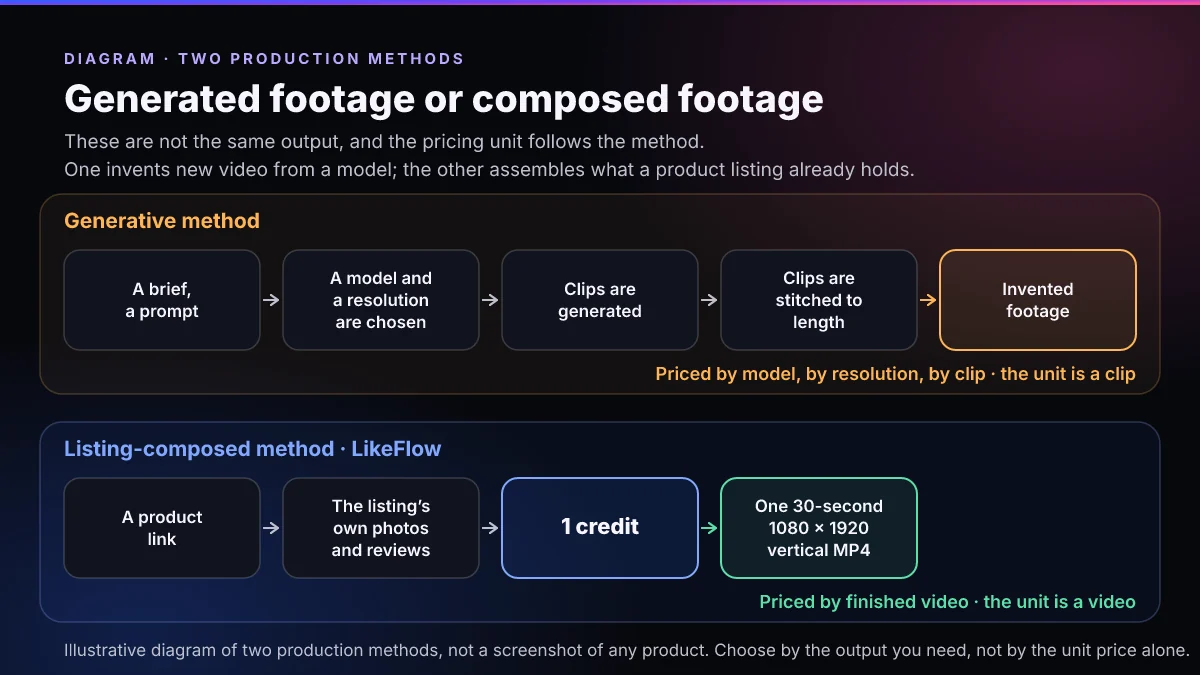
- You want generative footage, not composed footage. Those models invent new video. LikeFlow builds a 30-second vertical edit out of what is already on a product listing. If your brief is "a cinematic eight-second shot of the product on a wet street at night," Topview can attempt it and LikeFlow cannot.
- You want resolution beyond 1080×1920 vertical. Topview publishes 1080p, 2K and 4K tiers. LikeFlow renders one format.
- You are making something that isn't an ad. Short films, micro-drama, storyboarding — Topview has built named tooling for that. LikeFlow has not, and will not.
- You want a single agent across many jobs. "Just tell your agent" is a genuinely different workflow from "paste a link." Some people want the first one.
If two or more of those describe you, the rest of this page is context, not an argument. Buy Topview.
How LikeFlow prices the same 30-second video
Before the table, the framing that keeps it honest: these are not the same output. Topview's flagship path generates new footage from a model. LikeFlow assembles a 30-second vertical video from the real assets and real buyer reviews on a product link you paste — Amazon, Shopee or TikTok Shop. If you need invented cinematic footage, the comparison below is not the one that should decide your purchase. If you need a hundred product videos that accurately reflect a hundred listings, it is.
| Topview (as published) | LikeFlow | |
|---|---|---|
| Unit of pricing | Credits, priced per model × resolution × 4-second clip | One credit = one finished 30-second video |
| Entry price | Pro, "$16 per month, billed annually" — $192 for the year, paid up front. A month-to-month option also exists, at a price we are not quoting here (see the caption below this table) | Starter, $279 for the year on the annual plan, or $29 a month on the monthly one — both published prices. On the annual plan the credits arrive monthly, 100 at a time, and each month's unused credits expire when the next month's arrive — so it is 100 credits a month for twelve months, not a 1,200-credit pool for the year |
| What the entry price includes | 960 credits for the year on the annual plan | 100 credits per month |
| Cost of one 30-second video | Not published as a dollar figure; ≈$1.80–$22.20 on the Pro plan by our arithmetic, depending on model and resolution | $0.29 (our arithmetic: $29 ÷ 100) |
| Presenter-led UGC video | Not separately priced; depends on model routing | 5 credits = ≈$1.45 |
| Can you forecast a month's cost before paying? | Only if you fix the model, the resolution and the plan first; the published counts are per four-second video | Yes — multiply videos by credits |
| Free tier | None found on the pricing page on September 25, 2026 | 5 credits, no card |
| Do credits roll over? | Monthly plans: "Unused credits don't roll over to the next month." Annual plans, including the Pro plan above: credits granted upfront and reset every year | No — they reset each billing cycle |
| Failed renders | No published policy we could find | Refunded automatically |
| Where the script comes from | A brief, a script, an image or a URL | The listing's real buyer reviews, buyer photos and "Customers say" highlights |
| Output | Multiple models and resolutions up to 4K | One format: 1080×1920 vertical MP4 |
At higher volume the gap widens, because LikeFlow's credit price falls with plan size: Plus is $79 for 500 credits (≈$0.158 a video) and Ultra is $199 for 2,000 credits (≈$0.0995 a video). Those are our divisions of published plan prices. A year of Starter on the annual plan is $279, released as 100 credits a month that do not roll over — up to 1,200 finished 30-second videos if you use every month's allowance; twelve months of Topview Pro on its annual plan is $192 for 960 credits, which at Seedance 2.5 in 720p is about 21 videos of the same length. Same arithmetic, both directions — check the current plans yourself before you take our word for it.
If you are producing at catalogue scale, the arithmetic that matters is cost per finished video, not cost per plan — which is the whole subject of our guide to bulk video from a Google Sheet. And the wider cost model for affiliate video, including where the real bottleneck sits once production stops being one, is in our guide to Amazon affiliate video automation.
One last note on how the rest of this category prices, since you are probably comparing more than two tools. Topview publishes a great deal and it still does not resolve to a per-video number. Arcads keeps its pricing behind a signup — arcads.ai/pricing still returned a 404 at both hostnames we tried when we checked on September 25, 2026, and you must create an account to see a plan. Creatify publishes an actual formula — "5 credits per 15 seconds of video (rounded up)," which its own help centre still published when we checked on September 25, 2026, and which by our arithmetic makes a 30-second video ten credits. That is the most usable of the three, with one catch: the formula lives in the help centre, not on the pricing page, so check both. Three vendors, three different relationships with the question "what does one video cost."
What LikeFlow does NOT do
The list we would want if we were the buyer:
- No model selection. You do not choose Seedance, Veo, Kling or anything else. One pipeline, one look.
- No dubbing or translating an existing video. Nothing here takes a finished video and lays a new language track over it. The voice language is a choice you make when the video is generated, not a track added to it afterwards.
- Nothing in the video is built from your face or your voice. The presenter library is fixed and you choose from it. The picker unlocks the first three on the list for every account, paid plans included.
- No auto-posting. LikeFlow renders a 1080×1920 MP4 and a share link. Scheduling and publishing to TikTok, Reels or Shorts is yours to do.
- No client workspaces or multi-account management. Everything runs in one account.
- 30-second vertical videos only. Not two-minute explainers, not landscape, not 2K.
- Credits don't roll over. They reset each billing cycle. Failed renders are refunded automatically, so credits only go to videos that finish.
- The script comes from the listing, not from a brief you write. A listing with thin reviews produces a thin video, and no amount of volume fixes that.
- No tool of any kind writes your affiliate disclosure for you. Every affiliate video still needs its own disclosure and its own platform AI label.