
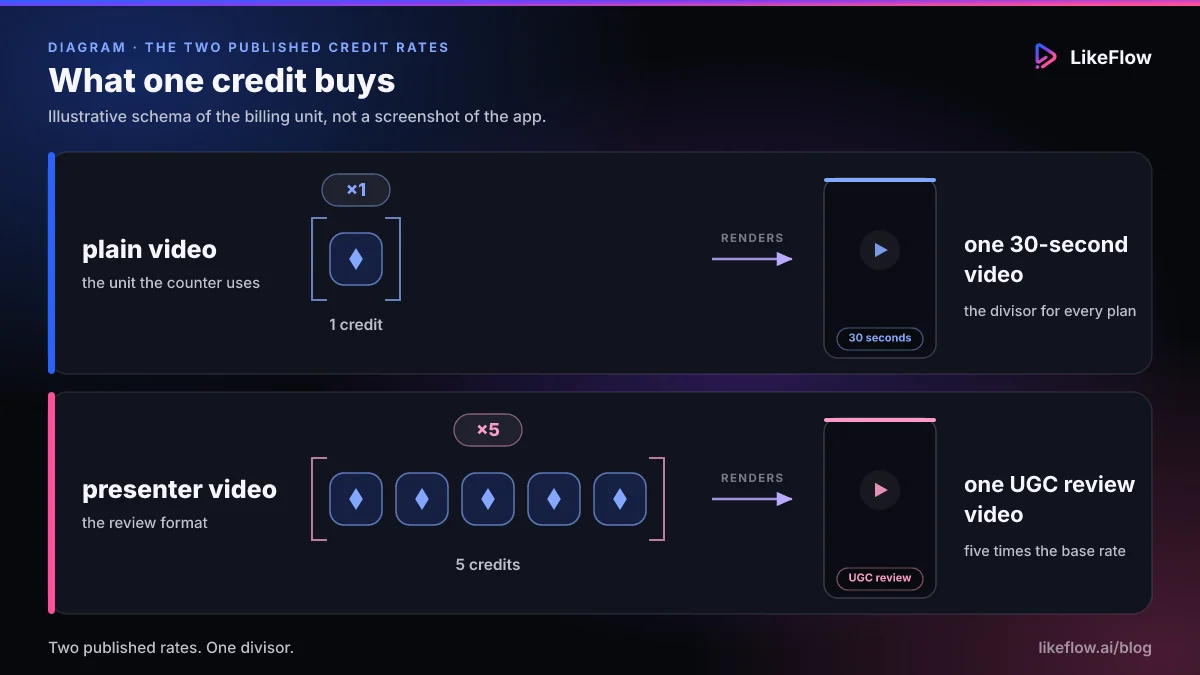
A credit is the billing unit for one rendered video. LikeFlow publishes two rules for it: “1 credit = 1 30-second video”, and “UGC review videos use 5 credits each”. The paid entry plan is $29 a month for 100 credits on monthly billing, so a 30-second video works out to ≈$0.29 and a UGC review video to ≈$1.45 — by our own arithmetic, on prices checked September 17, 2026.
Prices and credit rules on this page were read on likeflow.ai on September 17, 2026 and every source carries an access date in the footnote. LikeFlow publishes this page and sells the product being divided, so treat the arithmetic as something to redo rather than to trust: every division is written out in full so you can.
The short version
- The unit is a video, not a minute. One credit buys one 30-second video. That is the published rule, and it is the reason a credit count on this product converts straight into a video count without a second conversion step.
- Two rates are published; they are not the only rates LikeFlow charges. The published rules — 1 credit for a 30-second video, 5 for a UGC review video — are what this page divides by. Editing actions inside LikeFlow carry their own credit costs, each shown on the button that spends them before you click it. Those costs are not on the pricing page, so the counts below are the most videos the published rules allow, not a forecast of a working month.
- There is a second rate, and it is five times the first. A UGC review video costs 5 credits, not 1. If you came for review videos, that is your real rate — checked September 17, 2026.
- $29 ÷ 100 = $0.29. That division is the pricing story of the entry plan on monthly billing, and it is our arithmetic, not a per-video price published as such.
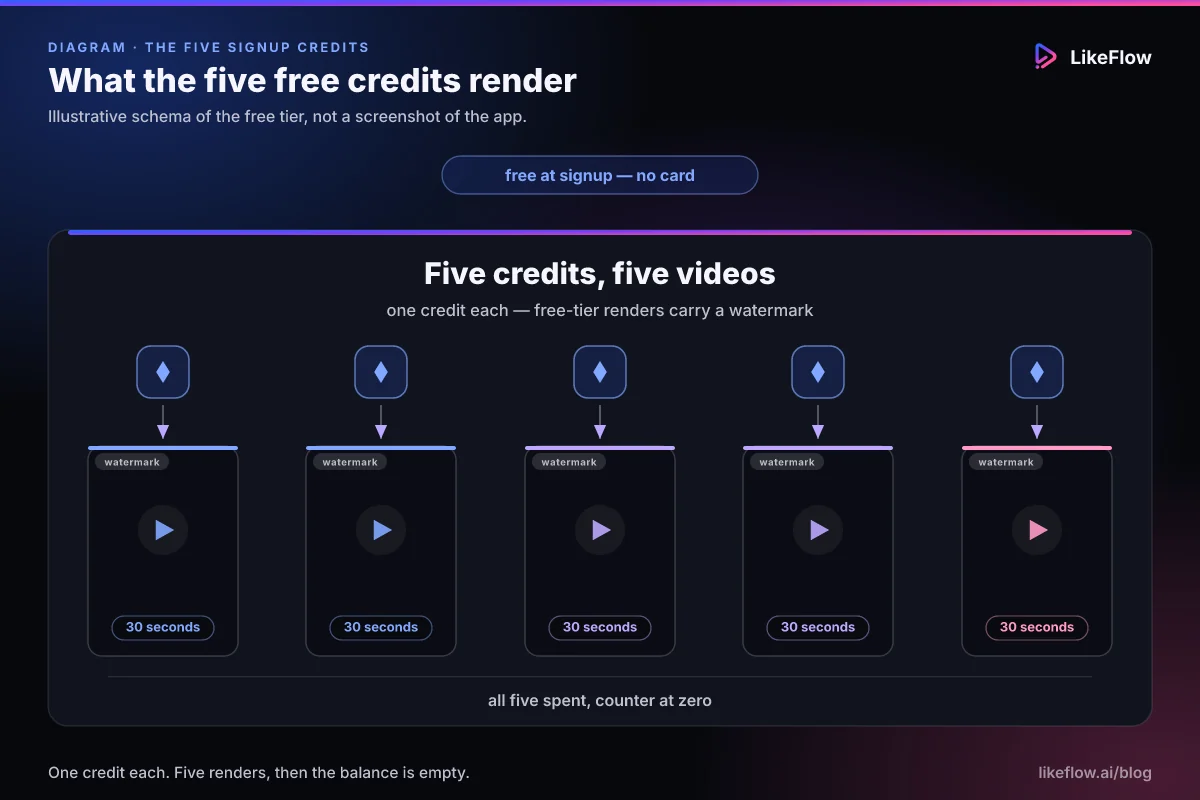
- The 5 free credits are five 30-second videos. That is the signup grant put through the standard rate, and the file you download carries the LikeFlow watermark: the free plan card lists “MP4 download (LikeFlow watermark)”, while “No watermark on every export” sits on the paid plans — read September 17, 2026.
- No per-video figure on this page is a published price. Every figure marked ≈ is ours — plan price ÷ included credits — and every division is written out in full so you can redo it.
What is a video credit, exactly?
A credit is a prepaid unit that a finished render consumes. It is not a token of compute time and not a minute of footage — it is a counter that goes down by a stated amount each time the product hands you a video. What makes the unit legible is that LikeFlow denominates it in videos: the published rule is an equals sign between one credit and one 30-second video, so the credit balance on the screen is a video balance.
LikeFlow publishes two rates, not one, and this is the part people miss. The product’s own interface
states them side by side in a note next to the credit counter — presenter video
{ugc} credits, plain video {video} in the interface strings, read
September 17, 2026 — with the two numbers filled in by the server rather than hardcoded in
the page.
| What you are making | Credits | Where that rate is stated | ≈ cost on the $29 / 100-credit plan, monthly billing |
|---|---|---|---|
| A 30-second video — “plain video” in the app | 1 | Pricing card on likeflow.ai: “1 credit = 1 30-second video” | ≈$0.29 ($29 ÷ 100) |
| A UGC review video — “presenter video” in the app | 5 | Pricing card on likeflow.ai: “UGC review videos use 5 credits each” | ≈$1.45 (5 × $0.29) |
| Anything longer than 30 seconds | Not stated | Neither published rule covers it | Not derivable from the published rules — do not assume it scales |
What does one video cost on each plan?
Take the plan price, divide by the credits it includes, and you have the cost of a 30-second video. Multiply that by five and you have the cost of a UGC review video. There is no third step, which is the only reason a table like this can be written at all.
| Plan | Published price and credits | ≈ per 30-second video | ≈ per UGC review video | What the month holds |
|---|---|---|---|---|
| Free | $0 — “5 free credits”, “No card required” | ≈$0.00 | — | Five videos at 30 seconds each (5 ÷ 1) — renders carry the LikeFlow watermark |
| Starter | $29 /mo — 100 credits / month | ≈$0.29 ($29 ÷ 100 = $0.29) | ≈$1.45 (5 × $0.29) | On monthly billing, 100 videos at 30 seconds each (100 ÷ 1), or 20 UGC review videos (100 ÷ 5) |
| Plus | $79 /mo — 500 credits / month | ≈$0.16 ($79 ÷ 500 = $0.158) | ≈$0.79 (5 × $0.158) | On monthly billing, 500 videos at 30 seconds each (500 ÷ 1), or 100 UGC review videos (500 ÷ 5) |
| Ultra | $199 /mo — 2,000 credits / month | ≈$0.10 ($199 ÷ 2,000 = $0.0995) | ≈$0.50 (5 × $0.0995 = $0.4975) | On monthly billing, 2,000 videos at 30 seconds each (2,000 ÷ 1), or 400 UGC review videos (2,000 ÷ 5) |
These figures are the monthly billing cycle, which is the default on the pricing page. Weekly billing buys fewer credits per dollar and annual billing buys more, so redo the division against whichever cycle you actually select — checked September 17, 2026.
One conversion is worth doing out loud, because it is the one a duration-based price list would force on you. On the $29 plan, 100 credits is 100 videos, which is 50 minutes of finished video if every one of them runs the full 30 seconds the rule describes. That conditional is doing real work — we are not publishing a minutes-based rate, we are pointing out that the videos-based rate converts into one and that the conversion is yours to check. Plan prices and credit counts read September 17, 2026.
What do the 5 free credits actually buy?
Five 30-second videos, with no card required at signup. That is the published grant put through the published rule and nothing more: the free plan card reads “5 free credits”, the credit rule reads “1 credit = 1 30-second video”, and five of the first is five of the second. Both strings read on likeflow.ai September 17, 2026.
So the honest description of the free tier is narrow and worth stating plainly: five finished files to judge, not a trial of the whole product. Free renders also carry the LikeFlow watermark: the free plan card lists its download as “MP4 download (LikeFlow watermark)”, while “No watermark on every export” sits on the paid plans. The difference is visible in the file you download, not in the credit arithmetic.
Why does a UGC review video cost five credits and not one?
Because it runs a different and more expensive pipeline, and the rate is set to reflect that rather than to price a feature tier. The comment sitting next to the constant in the source, read September 17, 2026, gives the reason in one line: the UGC path runs an extra GPU pipeline and is priced higher for it. That is a cost pass-through, not a packaging decision, which is why the multiple is a flat 5 on every plan instead of shrinking as you spend more.
The practical consequence is a planning one. An affiliate who intends to publish review videos should read the $29 plan as 20 videos a month, not 100, and should do that conversion before choosing a plan rather than after the balance runs out. The two rates are published, but the plan cards lead with the credit count, and a credit count only becomes a video count once you have decided which of the two things you are making.
What the price per video does not tell you
Stated plainly, because a pricing page that only divides is an advertisement:
- It is a ratio, not a quality claim. ≈$0.29 is what one tick of the counter costs you. It says nothing about whether the video is good enough to publish, and no per-video figure can.
- The free tier watermarks. So the ≈$0.00 row in the table above is not comparable to the paid rows on output, only on arithmetic.
- Editing time is not in the price. Our own team’s estimate, after the first few videos, is two to five minutes of human work per video before it is publishable. That is what our operators report, not a published measurement, and it is the line item every per-video price in this category leaves out.
- Only 30 seconds is defined. Both published rules describe a specific output. Anything else you might want is not covered by them, and we are not going to extrapolate a rate we cannot point at.
Why per-video cost is hard to compare between tools
Because “credit” is not a standard unit — it is a word each vendor defines for itself, and the definition is where the money is. Some vendors meter credits by the length of the video rather than by the video — where we have checked such a price list ourselves, the arithmetic and its access date live on the page linked just below, not here. A credit count on one price list and a credit count on another can differ substantially before anyone has mentioned a dollar. The only comparison that survives contact with a spreadsheet is the one that ends in a currency figure per finished video, and to get there you need the vendor’s own conversion rule, not its plan price.
This page deliberately does no competitor arithmetic — it defines our unit and divides by it, and that is all. Where we have done the same division on somebody else’s price list, it lives on its own page with its own access dates: Creatify pricing explained takes a credit-based vendor, and Arcads pricing explained takes a vendor that prices per video instead. Redo both if you are reading them months from now.